
Introduction
Over the past six months, the United States has gone through a major economic shift involving oil prices, energy markets, and the transition toward cleaner energy because of Iran’s shutdown of the Strait of Hormuz. As the conflict continues, oil prices have risen rapidly, affecting gasoline costs, transportation, and supply chains. Since the Strait of Hormuz is one of the world’s most important energy chokepoints, the effects extend far beyond the United States. About 20 percent of the world’s traded crude oil and liquefied natural gas passes through this 104-mile coastal channel. Because such a large share of the global energy supply moves through one narrow and politically unstable route, blockades, military threats, and regional conflict can quickly create worldwide economic consequences.
This crisis demonstrates why energy security must become a central goal of the global energy transition. Renewable energy can help reduce dependence on fossil fuels, but wind and solar alone cannot always provide the continuous, large-scale electricity that modern economies require. Nuclear energy offers a stronger foundation because it can produce reliable, low-carbon power without depending on oil shipments through vulnerable routes such as the Strait of Hormuz. Expanding nuclear energy alongside renewable sources could reduce exposure to global oil shocks and create a more secure and stable energy system during periods of political and economic difficulty.
What and Where is the Strait of Hormuz?
The Persian Gulf, the Gulf of Oman, and the Arabian Sea are all connected by the Strait of Hormuz, which is situated between Iran and Oman. Due to its location, the Strait is not only a noteworthy geographical feature but also one of the most crucial routes for transporting oil throughout the world and supporting the energy system. Iraq, Kuwait, Qatar, Saudi Arabia, Iran, and the United Arab Emirates are just a few of the nations that are well-known for producing oil inside or close to the Persian Gulf. The U.S. Energy Information Administration explains that although the marine strait has specific navigational routes for ships passing through, it is only about 21 miles wide at its narrowest point. Because of this, the effects of any war or conflict in this region will extend much beyond the Middle East.
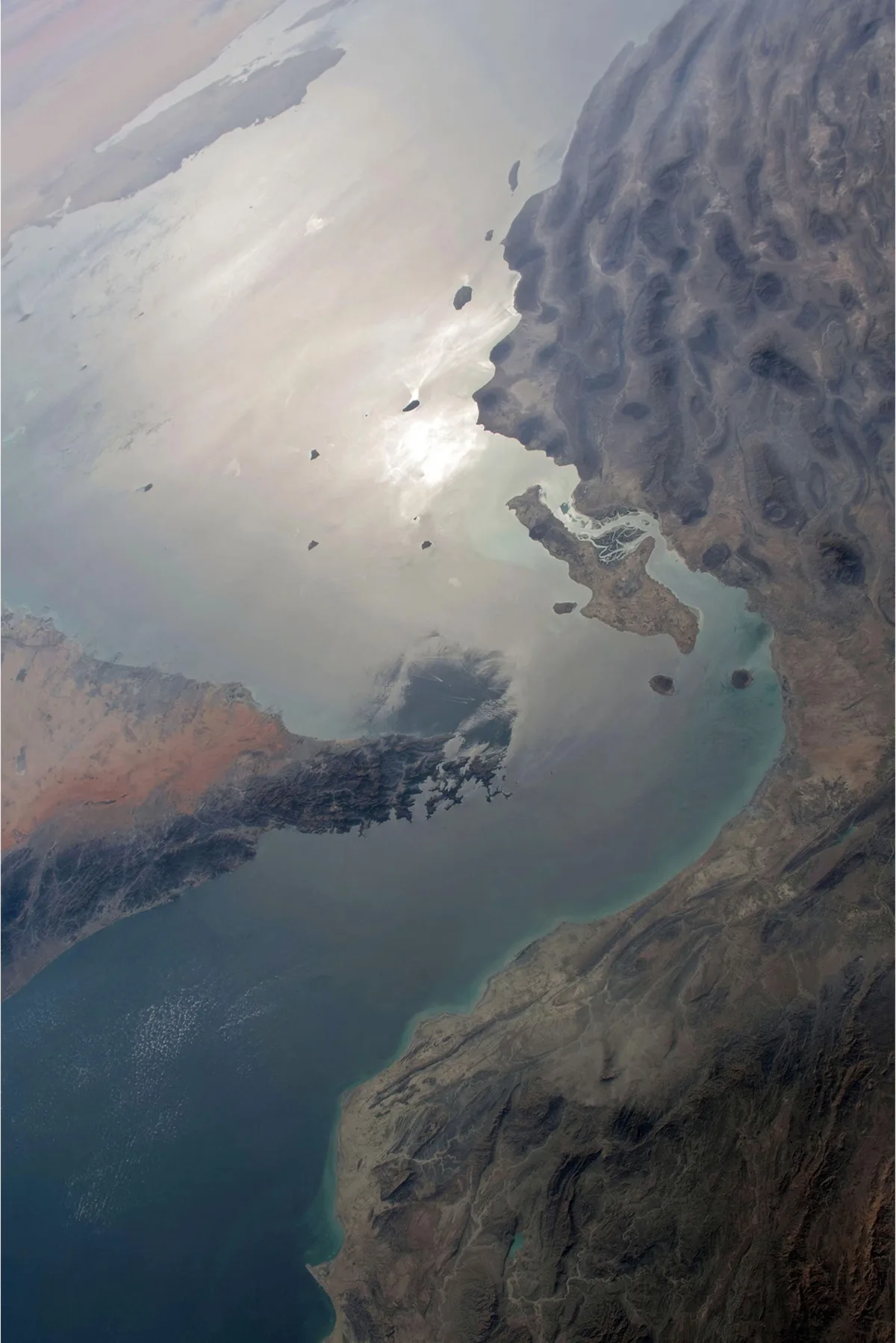
Why the Strait of Hormuz is a Critical Chokepoint
The U.S. Energy Information Administration estimates that in 2024, the average daily flow of oil through the Strait of Hormuz was 20 million barrels, or around 20% of the world's petroleum liquid consumption. Any disruption in the Strait can have an immediate impact on the world's energy markets because so much of the world's oil supply passes through this little waterway. The inability to transfer oil through a major chokepoint, even temporarily, can create supply delays, increase shipping costs, and increase world energy prices. The Strait is especially important and is difficult to replace because other countries have limited capacity in their ports and pipelines.
EIA data show how crucial the Strait of Hormuz is to the world's oil supply. Approximately 20 million barrels of petroleum, divided between crude oil and petroleum products, are transported through the strait each day. The strait lies between Iran and Oman, and only a few pipeline options, such as the East-West and Abu Dhabi crude oil pipelines, might partially make up for any disruptions to the strait.
The Geopolitical Risk: Iran, War, and Control of Shipping
The Strait of Hormuz is a geopolitical marker in addition to being a chokepoint for energy. Due to the fact that the strait connects many major regions together through a waterway, anyone who can endanger ships across it also poses a serious threat to a significant portion of the world's energy traffic. Because of this, the Strait of Hormuz is particularly risky when Iran, the US, Israel, or other Gulf states are at war or experiencing military conflict. In an article by Congress, “The Strait of Hormuz in Brief: Non-Oil Shipments and Effects on U.S. Shippers,” Congress explained how before U.S. and Israeli military operations against Iran began on February 28, 2026, roughly 130 ships per day traveled through the Strait. Since the operations began, far fewer ships have attempted to pass through the Strait because of the risk of attack by Iranian forces. Governments, insurance, and shipping firms all immediately modify their practices when a military crisis breaks out because it becomes considerably more expensive to cross the Strait. From March 1st to April 29th, 2026, the U.K. reported 23 attacks on vessels by the Maritime Trade Operations Center, and multiple crew members suffered injuries. Roughly 1,000 ships were waiting in the Persian Gulf as of April 2026. The strait is no longer an open commercial route if ships must wait for authorization, pay tolls, avoid specific routes, or rely on military protection.
| Date | Event |
|---|---|
| Before February 28 | About 130 ships crossed daily. |
| March 2026 | Emergency oil reserves were released to limit supply shortages. |
| March–April 2026 | Traffic declined as attacks and security risks increased. |
| Late June 2026 | Diplomatic progress led to a partial reopening and lower oil prices. |
How Oil Supply Risk Raises Crude Oil Prices
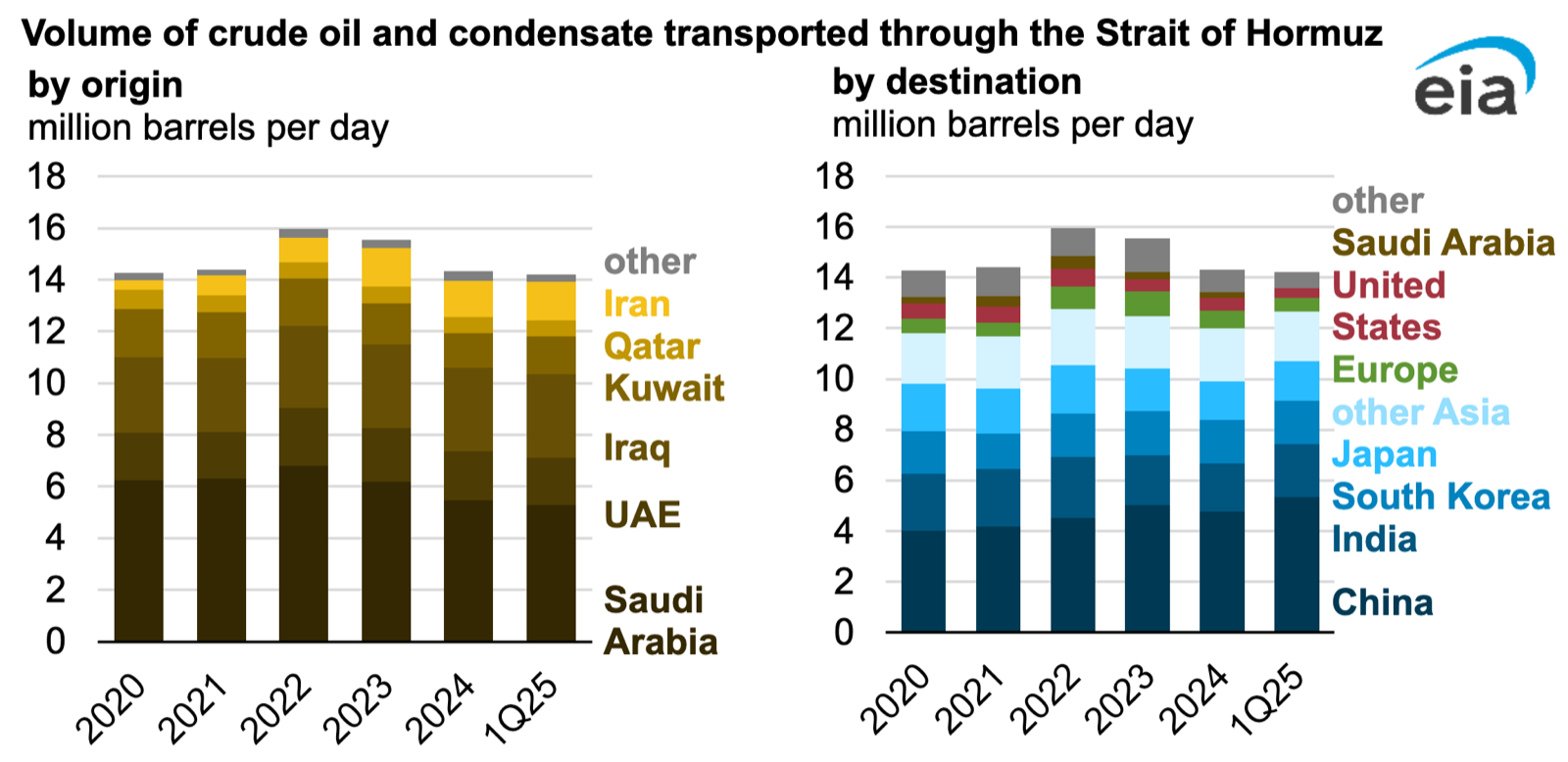
The price of Brent Crude oil went from $69 per barrel on June 12, 2024, to $74 per barrel on June 13, according to a 2024 report from the US Energy Information Administration. Because OPEC+ nations reduced production and exports, crude oil and condensate fell by 1.6 million barrels per day this year. Furthermore, Saudi Arabia accounts for 38% of all petroleum flows via the strait in 2024, making it the biggest mover of crude oil through Hormuz. IEA member nations decided to release 400 million barrels from emergency stockpiles. This is because emergency oil stocks are primarily a short-term fix, though they can be helpful for a while. Who sends and receives the crude oil that passes through the Strait of Hormuz is depicted in this EIA chart. Saudi Arabia is consistently the biggest provider, followed by the United Arab Emirates, Iraq, Kuwait, Qatar, and Iran, according to the left chart that breaks down shipments by origin. China is by far the biggest beneficiary, followed by India, South Korea, Japan, and other Asian countries, with the United States receiving a comparatively modest amount, according to the right graphic that breaks down imports by destination.
Why U.S. Gasoline Prices and Consumer Inflation Still Respond to Middle East Shocks
Oil is traded on a worldwide market, even though the United States does not directly obtain the majority of its oil from the Persian Gulf. Global crude oil prices may increase when a major route like Hormuz becomes hazardous, which may subsequently affect the cost of gasoline for American consumers. Additionally, the likelihood of long-term inflation pressure increases with the duration of high oil prices. The reopening of the Strait of Hormuz may result in a decrease in oil prices, a reduction in inflation expectations, and a partial recovery of stock market losses. According to a JP Morgan article, the stock market's response to previous oil shocks has been minimal thus far. Global energy equities have only climbed by roughly 8%, while oil prices have increased by almost 40%.

The J.P. Morgan chart tracks how the S&P 500 has performed around various military conflicts, indexing each conflict's start month to 100 so they can be directly compared. The overall average (dark blue line) demonstrates that the stock market typically experiences a slight drop at the beginning of a conflict before rising over the next two years. Notable outliers include the 1973 Arab-Israeli War, which resulted in a sharp and protracted market downturn because of the oil embargo, and Russia's invasion of Ukraine in 2022, which likewise caused markets to decline for a considerable amount of time. In contrast, the market had a substantial increase following more recent conflicts such as the Israel-Gaza War (2023). The orange line that tracks the U.S. strikes on Iranian nuclear sites in 2025 shows a fall at first, but it quickly recovers and stays near the average.
Renewable Energy as a Long-Term Solution to Oil Vulnerability
During times of oil vulnerability, having other sources of energy to rely on can be beneficial to reduce the side effects of what a lack of oil can create in our society. This can help provide an alternative way to become independent from fossil fuels that need to be transported through risky geopolitical bottlenecks such as the Strait of Hormuz. If countries use oil extensively, any disruption in the transport of oil through one specific shipping lane could lead to increased crude oil, gasoline prices and inflation. Nevertheless, if renewable energy could substitute for oil in transportation, heating, electricity production, and industry, this crisis would not affect the economy that much.
Energy transition refers to the change of energy production and consumption in favor of alternative, cleaner sources, including wind, solar power, and others. The problem is related to the issue of oil vulnerability, as it does not depend merely on the underground reserves of oil in the territory of a country. Instead, a country vulnerable to foreign energy sources faces higher risks of conflicts, transport problems, economic sanctions, and others. In turn, the more renewables a country uses for energy production, the more insulated it is from possible problems related to the importation of oil since the sun and the wind do not require passing through any military chokepoint.
For example, KPMG writes in their article titled "Energy Transition and Its Impact on the Oil and Gas Industry" that wind and solar power will become the dominant force in global energy consumption. According to their predictions, oil and gas demand may peak around 2030 under the influence of consistent energy policies. Moreover, fossil fuels may remain a significant component of energy production in 2050, but with less significance than currently. However, they are unlikely to dominate in industries that can be decarbonized entirely. According to their estimates, demand for fossil fuels could peak by 2030 if current policies on the use of clean energy persist. Besides, fossil fuels will still be employed in 2050, yet in smaller amounts and in sectors which are difficult to make emission-free. To switch to other sources of energy, oil and gas businesses will have to adopt new technologies and practices.
Looking at World Energy Outlook Post COVID-19
Prior to COVID-19, the World Energy Outlook (2019) by the International Energy Agency explained how renewables were growing by 50% and gas by 35%. Additionally, they emphasized the point of a continued need for seeking energy security. The paper even stated that “Increased flexibility in global gas trade, thanks largely to liquefied natural gas (LNG), helps to underpin confidence in global gas supply…” Researchers are aware of how important it is to have energy security, especially during times of concern. However, people during this period were not yet aware of the global crises that were going to occur the following year.
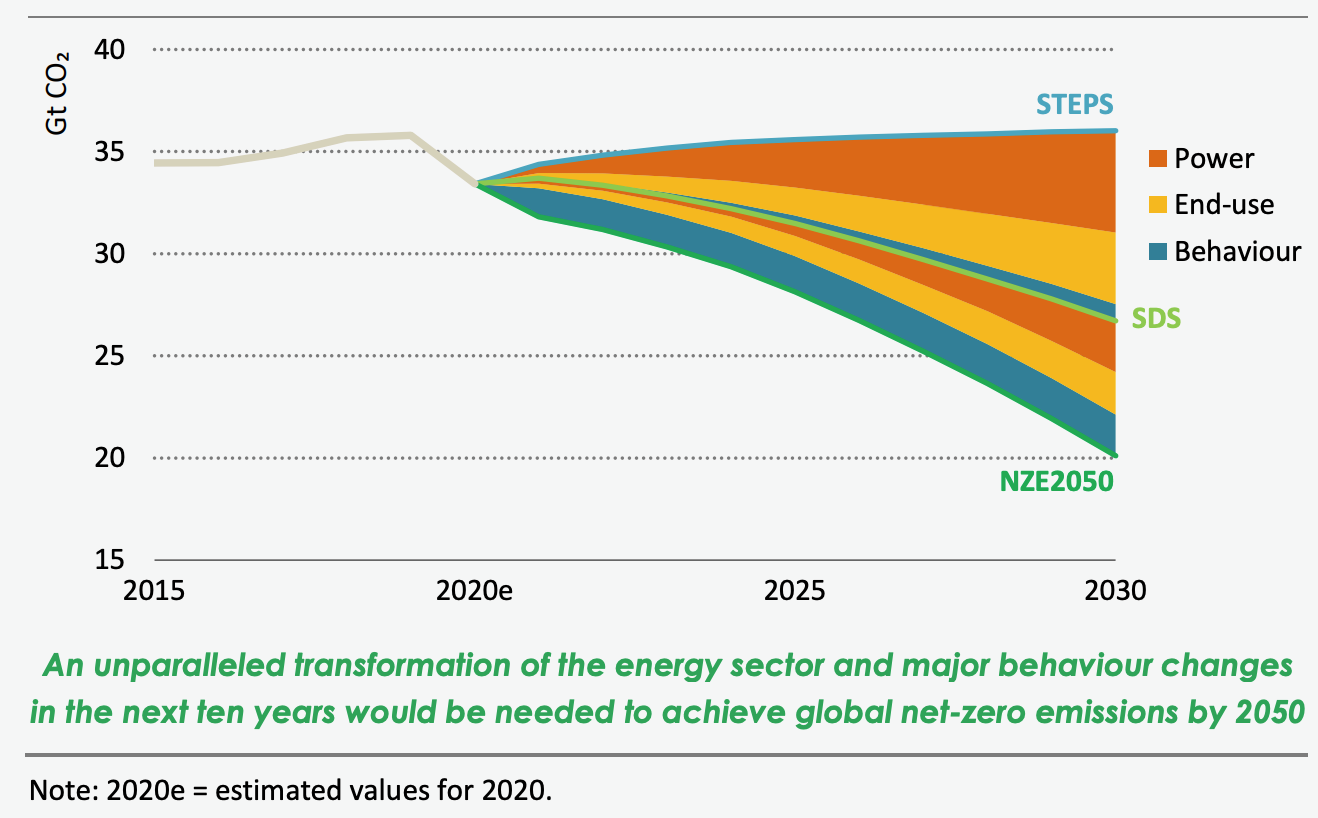
A year later, the WEO focused on building a sustainable recovery from the economic side effects of the COVID-19 crisis. One direct impact of the crisis was how energy demand in 2020 was set to fall by around 5% from 2019 levels. As fossil fuel prices were falling, using oil or gas became less expensive, making clean-energy upgrades less appealing to consumers. So overall, the drop in economic activity and the rising uncertainty in the future of the economy regarding energy led WEO to predict a slower incentive for capital stock. Furthermore, the paper covered what actions would be necessary to reach net-zero emissions by 2050. Several countries showed interest in reducing emissions through initiatives such as the Sustainable Development Scenario (SDS). The graph below shows Energy and Industrial process CO2 emissions and reduction levers in the scenarios. The gray line reflects the estimated emissions before and during 2020, and the sharp drop around 2020 largely reflects the economic slowdown at that time. STEPS (Stated Policies Scenario) represents the assumption that governments will follow the energy and climate policies, creating a scenario where emissions will rise slightly and reach about 26 Gt CO2 in 2030. SDS (Sustainable Development Scenario) depicts a future heavily shifted towards a clean energy movement, causing emissions to fall by 27 Gt CO2 by 2030. Last, NZE2050 (Net Zero Emissions by 2050) details an even cleaner energy society, with emissions dropping to 20 Gt CO2 by 2030. The primary message here is that existing policies are not enough to reach net zero, and that society must take greater action in order to create rapid changes in electricity production, transportation, and behavioral changes. In the section covering a delayed recovery, they predicted the global economy to be only 5% smaller by 2025.
At the start of 2021, China, Russia, and Korea successfully constructed many nuclear power projects with the help of policy targets and the 60 GW of capacity under construction in 19 countries at the start of this year. Additionally, the WEO went over how a new energy economy is emerging, despite the struggles COVID-19 created for the economy. In the past two decades, electric vehicles and new implementations of renewable energies such as wind and solar PV have increased at the fastest rate in the past two decades. At this point in time, electricity stands at 20% in world energy consumption, taking on a greater role in the lives of consumers and well-being. This is because the reliability and affordability of electricity are predicted to play an even more prominent role in people's lives. Furthermore, in the NZE, they extended greater efforts to create safe operation for nuclear power, intending to work on advancing nuclear power technologies such as modular reactors. This would help produce low emissions in electricity, heat, hydrogen, and an estimated increase in nuclear energy output by 15% in 2030. However, the outlook for nuclear power depends not only on the objectives of the NZE, but also on advancing reactors and pursuing new construction.
The World Energy Outlook 2022 marked how nuclear energy was viewed, presenting it not only as a low-carbon technology but also as a way to strengthen electricity security during the global energy crisis. Under the IEA’s Stated Policies Scenario, nuclear power was projected to maintain roughly 10% of global electricity generation, requiring approximately 120 GW of new capacity between 2022 and 2030 and another 300 GW between 2030 and 2050. The Announced Pledges Scenario projected average additions of about 18 GW per year, while the Net Zero Emissions scenario required approximately 24 GW annually, more than doubling global nuclear capacity by 2050. Although nuclear’s share fell to approximately 8% in the net-zero pathway because total electricity demand grew so rapidly, the report established nuclear power as an increasingly important source of reliable, low-emissions electricity following the pandemic and Russia’s invasion of Ukraine.
The World Energy Outlook 2023 strengthened the case that a global nuclear revival was beginning. Nuclear remained the world’s second-largest source of low-emissions electricity after hydropower and supplied approximately 9% of global electricity. In the Stated Policies Scenario, global nuclear capacity increased from 417 GW in 2022 to 620 GW by 2050, driven mainly by China and other emerging economies, while advanced economies extended reactor lifetimes and pursued new construction to offset retirements. More ambitious climate policies raised projected capacity to approximately 770 GW in the Announced Pledges Scenario and more than 900 GW in the Net Zero Emissions scenario by 2050. Compared with the 2022 Outlook, the 2023 report therefore showed a more concrete and measurable nuclear resurgence, supported by policy changes, reactor lifetime extensions and growing interest in small modular reactors.
The World Energy Outlook 2024 showed that the nuclear resurgence identified in earlier editions was beginning to appear in actual construction and operating data. Nuclear still provided approximately 9% of global electricity, but five new reactors totaling 5.5 GW entered operation in 2023, while the restart of another 1.6 GW more than offset the 6.3 GW of capacity retired that year. During the first nine months of 2024, another 4.5 GW was connected to the grid, and by October approximately 75 GW across 62 reactors was under construction—enough to increase global nuclear capacity by nearly 20% once completed. The report projected accelerating capacity additions in every scenario through 2035, with emerging economies leading the expansion; China alone accounted for approximately 40% of additions in the Stated Policies Scenario and nearly 50% in the Net Zero Emissions scenario. The report therefore moved beyond discussing a possible nuclear comeback and documented a growing project pipeline, although it also noted that nuclear expansion remained slower than the growth of wind and solar power.
The World Energy Outlook 2025 presented the strongest evidence of a sustained nuclear comeback. It expected global nuclear generation to reach a record level in 2025 and noted that more than 40 countries had incorporated nuclear power into their energy strategies. In the Current Policies Scenario, global nuclear capacity increased by approximately 75% by 2050, with China expected to become the world’s largest nuclear operator around 2030. Under the stronger Stated Policies Scenario, nuclear output rose by nearly 40% by 2035 and then by a further 40% between 2035 and 2050, while maintaining just under 10% of global electricity generation as total power demand expanded. The Net Zero Emissions scenario required a much faster transformation: installed nuclear capacity rose 70% by 2035 and reached approximately 2.5 times its current level by 2050, with annual additions reaching around 40 GW during the 2030s. Taken together, these figures show that between 2022 and 2025, the IEA’s treatment of nuclear energy evolved from identifying its potential contribution to post-Covid energy security to documenting a broad, policy-supported expansion in construction, investment and projected output.
The Impact of Expanding Nuclear Energy
The limits of renewable energy do not mean the world should abandon the energy transition. Instead, they show why the transition needs a dependable source of low-carbon electricity that can operate at all times. Nuclear energy can provide that foundation because it produces large amounts of electricity without depending on sunlight, wind, or daily weather conditions.
The environmental impact of nuclear energy could be significant. Nuclear plants do not release carbon dioxide while generating electricity, although emissions still occur during construction, uranium mining, fuel processing, and decommissioning. Even after those stages are considered, nuclear remains a low-carbon energy source. MIT reports that nuclear power produces more than 40 percent of the carbon-free electricity in the United States. The International Energy Agency estimates that nuclear energy has prevented about 55 billion metric tons of carbon dioxide emissions worldwide over the past five decades. This shows that nuclear power has already played a major role in reducing fossil-fuel use and emissions.
Nuclear energy could also improve grid reliability. According to the U.S. Department of Energy, American nuclear plants operated at more than 92 percent of their maximum capacity in 2024, much higher than wind or solar. Nuclear plants can generate electricity continuously for long periods between refueling shutdowns, making them useful when renewable output is low. This reliability is becoming more important as electricity demand rises because of electric vehicles, heat pumps, industrial electrification, artificial intelligence, and data centers.
J.P. Morgan has noted that data centers are expected to drive a large share of future U.S. electricity-demand growth. This has increased interest in nuclear energy because technology companies and utilities need large amounts of dependable, low-carbon power. Wind and solar can help meet this demand, but they require storage, transmission, and backup generation. Nuclear energy can provide steady electricity while renewable sources add power when weather conditions are favorable.
Nuclear energy can also strengthen national energy security. Nuclear plants do not depend on constant fuel deliveries through pipelines or major shipping routes. A relatively small amount of uranium can provide electricity for a long period, reducing exposure to disruptions in oil and natural-gas markets. The International Energy Agency argues that nuclear power can support cleaner electricity systems while reducing dependence on volatile fossil-fuel supplies.
However, nuclear energy also has economic challenges. New reactors can be expensive, take years to build, and suffer from delays or cost overruns. J.P. Morgan and MIT have both emphasized that nuclear energy will become more competitive only if governments and companies improve project management, standardize reactor designs, and avoid repeatedly building completely different plants. In the near term, extending the lives of safe existing reactors and restarting selected closed facilities may be more practical than relying only on new construction.
Nuclear power would not immediately replace oil in aviation, shipping, plastics, or heavy industry. Its impact would come from expanding electrification. Nuclear electricity could power electric vehicles, factories, rail systems, heat pumps, data centers, and hydrogen production. As more economic activity shifts from fossil fuels to electricity, nuclear energy could gradually reduce the power that oil and gas disruptions have over the global economy.
For these reasons, nuclear energy should serve as the stable foundation of the energy transition. Wind, solar, hydroelectric power, batteries, and energy efficiency should continue expanding, but they should be supported by nuclear plants that can generate electricity continuously. Nuclear energy has real challenges involving cost, waste, safety, and construction time, but those risks must be compared with the consequences of continued fossil-fuel dependence and unreliable electricity supply.
The Limits of the Energy Transition
Despite the advantages of nuclear power, critics argue that it should not become the central solution to the energy transition because nuclear plants create concerns involving safety, radioactive waste, environmental damage, and cost. Germany and New York’s Indian Point Energy Center are two major examples used to support this counterargument. Their experiences show why some governments have concluded that the risks and environmental consequences of nuclear power outweigh its benefits.
Germany’s nuclear phaseout was primarily driven by public fear of nuclear accidents and decades of political opposition. The country’s anti-nuclear movement began in the 1970s and became stronger after the 1986 Chornobyl disaster. Germany originally reached an agreement to phase out nuclear energy in 2000, but the Fukushima disaster in Japan on March 11, 2011, caused the government to accelerate the policy. Germany’s Federal Office for the Safety of Nuclear Waste Management states that Fukushima directly led the German Parliament to approve the nuclear phaseout. Eight reactors were shut down shortly after the accident, and the government planned to close the remaining reactors by the end of 2022. Because of concerns about energy shortages following the decline in Russian natural-gas imports, Germany temporarily extended the operation of its final three reactors until April 15, 2023. Those three plants were then permanently shut down, ending commercial nuclear-power generation in Germany.
Germany’s decision presents a legitimate counterclaim because nuclear accidents, although rare, can cause severe and long-lasting damage. Nuclear plants also produce radioactive waste that must be securely managed for extremely long periods, while constructing new reactors can require large initial investments and many years of planning and construction. German leaders therefore argued that wind, solar, efficiency improvements, and grid expansion would provide a safer long-term energy system. Public opposition was so strong that the phaseout continued even during the European energy crisis, when the loss of Russian gas increased concerns about electricity prices and energy security.
A similar counterclaim can be seen in the shutdown of the Indian Point Energy Center in New York. Indian Point was a nuclear facility located on the Hudson River approximately 24 miles north of New York City. Its two final operating reactors shut down on April 30, 2020, and April 30, 2021. The plant had generated approximately 2,000 megawatts of electricity, making it an important source of power for the New York metropolitan region. However, New York State reached a legal agreement with the plant’s owner, Entergy, to close the facility after years of environmental and public-safety disputes.
Opponents of Indian Point argued that its location near one of the most densely populated areas in the United States created an unacceptable risk if a serious accident or attack occurred. Environmental organizations also argued that the plant’s cooling system withdrew enormous amounts of water from the Hudson River, killing fish, eggs, larvae, and other aquatic organisms. New York environmental officials have identified Indian Point’s closure as an important factor in reducing mortality among Hudson River fish populations. These concerns demonstrate that even carbon-free energy production can create local environmental damage that governments must consider.
However, Germany and Indian Point do not prove that nuclear energy should be rejected altogether. Instead, they demonstrate that nuclear projects must be carefully located, strongly regulated, technologically modern, and supported by credible waste-management and emergency-response systems. Closing existing nuclear plants can also create serious tradeoffs. Nuclear reactors provide large amounts of dependable electricity without emitting greenhouse gases during operation. Unlike wind and solar facilities, they can operate continuously regardless of weather conditions. U.S. nuclear plants operated at full capacity more than 92 percent of the time in 2023, and nuclear power continues to generate approximately one-fifth of U.S. electricity.
Germany’s own actions during the energy crisis reveal this tradeoff. The government kept its final reactors operating for several additional months because reduced Russian gas imports created concerns about electricity shortages. This suggests that nuclear energy still provided energy-security value even as Germany completed its phaseout. Indian Point creates a similar question: eliminating a major source of carbon-free, continuous electricity does not automatically guarantee that renewable energy will be ready to replace all of its output. When nuclear capacity is retired before sufficient clean replacement capacity is available, natural gas or other fossil-fuel generation may be required to fill the gap. Therefore, the stronger lesson from Germany and Indian Point is not that nuclear energy is inherently unsuitable, but that governments must compare its risks with the economic, environmental, and security risks of remaining dependent on fossil fuels.
The energy transition should be understood as both a long-term effort to reduce oil vulnerability and an immediate effort to construct a cleaner, more reliable energy system. Renewable energy, electric vehicles, hydrogen, carbon capture, and energy efficiency will all contribute to this transition. However, these technologies cannot independently provide the consistent, large-scale energy supply required by modern economies. Wind and solar are essential, but their output changes with weather conditions and requires major investments in storage, transmission, and backup generation. Hydrogen and carbon capture remain expensive and are not yet available at the scale needed to replace fossil fuels across transportation and heavy industry.
For these reasons, nuclear energy is the best primary energy source for countries seeking to move away from fossil fuels. Nuclear plants can produce enormous amounts of electricity continuously, require relatively little land, and generate power without releasing carbon dioxide during operation. Their high capacity factors make them more dependable than weather-dependent renewable sources, while their domestic electricity production can reduce exposure to unstable global oil and natural-gas markets. Nuclear energy cannot immediately eliminate oil use in aviation, shipping, or petrochemicals, but it can provide the reliable electricity needed to expand electric transportation, produce low-carbon hydrogen, power industrial facilities, and support the growing electricity demands of artificial intelligence and data centers.
The examples of Germany and Indian Point show that nuclear power has real challenges. Safety, waste disposal, environmental protection, construction costs, and public trust cannot be ignored. Nevertheless, abandoning nuclear energy because of these difficulties would replace a manageable set of engineering and regulatory problems with the much larger dangers of fossil-fuel dependence, climate change, unreliable electricity supplies, and exposure to geopolitical crises. The correct response is not to shut down safe nuclear facilities without adequate replacements. It is to improve reactor safety, develop advanced reactor designs, establish permanent waste-storage systems, and ensure that nuclear plants are built in suitable locations.
A diverse energy system will still require wind, solar, hydroelectric power, storage, and energy efficiency. However, nuclear power should form the stable foundation of that system. Renewables can provide additional clean electricity when conditions allow, while nuclear plants provide continuous power when the sun is not shining and the wind is not blowing. This combination would be more reliable and more capable of replacing fossil fuels than a system that depends mainly on intermittent renewable generation.
Until transportation, aviation, shipping, and industry rely much less on oil, a disruption in the Strait of Hormuz can still increase global oil prices, raise U.S. gasoline prices, and contribute to inflation. Emergency oil reserves, demand-reduction measures, and diplomatic efforts therefore remain necessary in the near term. In the long term, however, the strongest protection against repeated fossil-fuel supply shocks is a major expansion of nuclear energy alongside renewable technologies. Nuclear energy is not a perfect solution, but it is the most practical, reliable, and powerful option available for leading the global transition away from fossil fuels.
Conclusion: Nuclear Energy and Long-Term Energy Security
The Strait of Hormuz demonstrates that dependence on fossil fuels is not only an environmental problem but also a major economic and national-security risk. When one narrow waterway can threaten global oil supplies, raise gasoline prices, disrupt trade, and increase inflation, the world’s energy system is dangerously exposed to political conflict. Emergency oil reserves, alternative pipelines, and diplomacy can reduce the damage of a crisis, but they cannot eliminate the underlying dependence that makes the crisis so powerful.
The strongest long-term response is to build an energy system centered on nuclear power and supported by renewable energy. Nuclear energy cannot immediately replace oil in aviation, shipping, and industry, but it can provide the dependable, low-carbon electricity needed to expand transportation electrification, hydrogen production, manufacturing, and other alternatives to fossil fuels. Its continuous output also makes it more reliable than an energy system based mainly on weather-dependent sources.
Nuclear power has real challenges involving cost, waste, construction time, and safety. However, the examples of Germany and Indian Point show that abandoning nuclear energy can also weaken energy security when dependable clean power is removed before adequate replacements are available. During periods of political conflict and economic uncertainty, countries need energy sources that are reliable, domestically controlled, and less vulnerable to unstable global fuel markets. For that reason, nuclear energy offers the strongest foundation for reducing dependence on chokepoints such as the Strait of Hormuz and creating a cleaner, more secure, and more economically stable energy future.